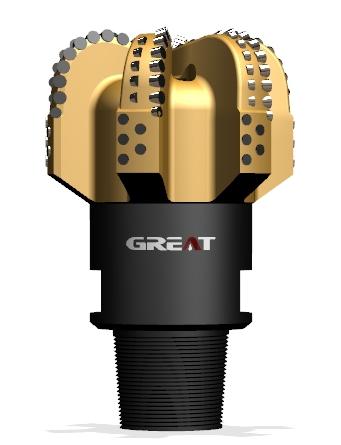
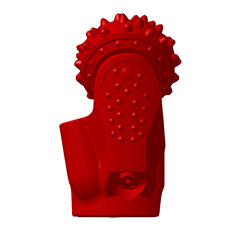
In the drilling industry, "price" and "cost" are two very different things. A cheaper drill bit that fails halfway through a deep well can cost you tens of thousands of dollars in tripping time and rig downtime.
As a procurement manager or drilling engineer, choosing the right tricone drill bit—specifically between TCI (Tungsten Carbide Insert) and Steel Tooth (Milled Tooth)—is the most critical decision affecting your Cost Per Foot (CPF).
At Cangzhou Great Drill Bits Co. Ltd., we’ve spent over a decade manufacturing top-tier bits for giants like CNPC and SINOPEC. Today, we break down the technical differences to help you choose the right tool for your formation.
1. The Contenders: What’s the Difference?
Before calculating ROI, we must understand the mechanics.
Steel Tooth Bits (Milled Tooth)
These bits are machined directly from a forged steel cone. The "teeth" are part of the cone itself.
Best for: Softer formations like soft limestone, clay, sand, or shale.
Mechanism: They crush and gouge the rock.
The Advantage: Lower upfront cost and higher Rate of Penetration (ROP) in soft, sticky layers. Great Drill Bits enhances these with premium hard-facing tungsten carbide to resist abrasion.
TCI Bits (Tungsten Carbide Insert)
Often called "button bits," these feature tungsten carbide inserts pressed into precision-drilled holes in the cone.
Best for: Medium to extremely hard formations (hard limestone, chert, granite).
Mechanism: They crush and fracture the rock through high compressive stress.
The Advantage: Extreme durability. While the initial investment is higher, TCI bits last significantly longer in abrasive environments.
2. ROI Analysis: When to Spend More to Save More
The decision comes down to the geology of your bore path. Here is the rule of thumb we use at our Hebei manufacturing base:
Scenario A: The Soft Formation Sprint
If you are drilling a water well in shallow, sandy soil, a Steel Tooth Tricone Bit is your ROI king. Using an expensive TCI bit here is overkill; it won't drill faster, and you won't utilize its longevity benefits before the hole is finished.
Scenario B: The Deep Hard Rock Marathon
This is where TCI Bits shine. In deep oil & gas drilling or hard rock HDD projects, tripping out to change a worn-out bit takes hours (or days).
The Math: If a TCI bit costs 3x more but lasts 5x longer than a steel tooth bit, your Cost Per Foot drops dramatically.
Tech Insight: Our TCI bits utilize advanced diamond material technology. Since 2010, we have specialized in the R&D of these super-hard materials, ensuring our inserts resist heat and wear better than standard market options.
3. The "Great" Advantage: Precision Matters
Whether you choose Steel Tooth or TCI, the geometry of the bit determines its life. A poorly machined bit will wobble, destroying the bearings prematurely.
This is where manufacturing capability becomes a game-changer. At Cangzhou Great Drill Bits, we don’t just assemble parts. We utilize:
This precision is why our bits (ranging from 3" to 26") are trusted by CNOOC and international clients for critical projects.
4. How to Read the IADC Code
Don't guess—use the IADC code to confirm your choice.
Series 1, 2, 3: Steel Tooth (1 is softest, 3 is hardest).
Series 4, 5, 6, 7, 8: TCI (4 is softest, 8 is hardest).
Need help decoding? Send us your formation details, and our engineers will match the IADC code for you.
Conclusion
Choosing between TCI and Steel Tooth isn't just about the budget; it's about the mission.
Choose Steel Tooth for speed in soft, shallow holes.
Choose TCI for endurance in hard, deep, or abrasive formations.
Ready to optimize your drilling operations?Whether you need a specialized Matrix body PDC or a rugged Tricone Rock Bit, Great Drill Bits has the capacity (10,000+ pcs/year) to supply your project.
Contact Us Today for a quote or technical consultation. Let’s lower your drilling costs together.
 English
 français
 Deutsch
 Español
 italiano
 русский
 português
 العربية
 tiếng việt
 ไทย
ไทย Nederland