BLUF: Selecting the correct Tungsten Carbide Insert (TCI) Tricone bit requires a precise match between the insert geometry, bearing design, and the rock formation’s Compressive Strength (UCS). For optimal Rate of Penetration (ROP) and bit life, engineers must balance cutter density against formation abrasiveness and hardness, utilizing high-quality steel body construction to withstand extreme downhole vibrations.
Key Takeaways
Formation Matching: Use IADC classification codes to align bit series (4xx-8xx) with formation hardness (Soft to Ultra-Hard).
Bearing Integrity: Journal bearings are superior for high-RPM applications; sealed bearings are critical for avoiding premature failure in abrasive fluids.
Optimization Metrics: Focus on Cost-Per-Foot (CPF) rather than raw ROP to determine true economic efficiency.
GREAT Expertise: With over a decade of manufacturing experience, GREAT leverages 5-axis CNC precision and advanced tungsten carbide metallurgy to deliver industry-leading performance.
For a complete Tricone Drill Bit Guide here.
What is a TCI Tricone Bit and How Does It Work?
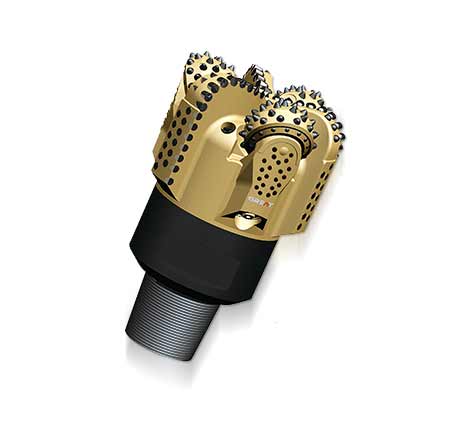
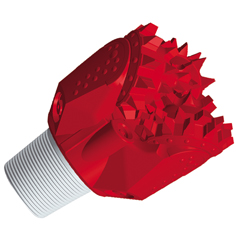
A TCI (Tungsten Carbide Insert) tricone bit consists of three rotating cones equipped with tungsten carbide compacts rather than milled steel teeth. These bits utilize a combination of crushing and gouging actions to disintegrate rock. As the drill string rotates, the cones turn, pressing the carbides into the formation with high weight-on-bit (WOB), causing the rock to fracture.
If you are looking for steel tricone bit, go to the steel tooth tricone bit guide.
.jpg "tricone_bit_(8).jpg")
How to Select the Correct TCI Tricone Bit?
Selecting a TCI bit is an exercise in balancing Rate of Penetration (ROP) against bit life. The primary tool for this selection is the IADC (International Association of Drilling Contractors) code system.
1. Matching the IADC Code
IADC 4-Series: Best for soft formations with high drillability.
IADC 5-Series: Versatile bits for medium-strength formations.
IADC 6/7/8-Series: Specialized bits for hard, abrasive, and high-compressive strength rocks.
2. Considering Rock Mechanics
Engineers must evaluate the Unconfined Compressive Strength (UCS) of the formation. A bit designed for soft shale will fail prematurely in high-quartz content sandstone due to excessive insert wear and bearing failure.
| Formation Type | IADC Range | Insert Shape | Recommended WOB/RPM |
|---|
| Soft/Medium | 417-447 | Chisel | High WOB / Med-High RPM |
| Medium/Hard | 517-547 | Modified Chisel | Med WOB / Med RPM |
| Hard/Abrasive | 617-737 | Conical/Ovoid | High WOB / Low RPM |
How Does the IADC Code Guide TCI Tricone Selection?
The International Association of Drilling Contractors (IADC) classification system is the bedrock of bit selection. For TCI Tricone bits, the code identifies the formation suitability and bearing type. A typical 4-digit code (e.g., 537) tells an engineer exactly what the bit is built for.
First Digit (1-8): Indicates the formation hardness. 1-3 are for steel tooth bits, while 4-8 are designated for TCI bits.
Second Digit (1-4): Represents the specific formation hardness within the series (1 is softest, 4 is hardest).
Third Digit (1-7): Defines the bearing/seal design, ranging from standard roller bearings to air-cooled or sealed journal bearings.
Fourth Digit (Alpha): Indicates additional features like gage protection or specialized cutting structures.
Why Does Bearing Selection Matter?
The bearing is the heart of the tricone bit. In deep-well environments, thermal fatigue is the leading cause of premature failure. GREAT utilizes advanced metallurgy and sealed journal bearing systems that utilize high-pressure compensation systems to prevent drilling fluid infiltration.
Which TCI Insert Geometry is Right for Your Formation?
The geometry of the tungsten carbide insert is the most critical factor in determining how a bit breaks rock. Engineers at GREAT categorize these into three distinct profiles:
Chisel Inserts: Best for soft to medium-hard formations where high ROP is achieved through aggressive impact and shearing.
Conical Inserts: Designed for medium to hard formations. These provide a balance between durability and penetration, offering excellent resistance to impact loading.
Spherical/Hemispherical Inserts: Optimized for extremely hard, abrasive formations (like chert or quartzite). These inserts provide maximum strength and resistance to breakage under high Weight-on-Bit (WOB).
Comparison: TCI Tricone vs. PDC Bits
| Feature | TCI Tricone Bit | PDC Drill Bit |
|---|
| Formation Hardness | Soft to Ultra-Hard | Soft to Medium-Hard |
| Failure Mode | Bearing wear/Insert breakage | Cutter chipping/Thermal degradation |
| Drilling Dynamics | Better in interbedded formations | Higher ROP in homogeneous rock |
| Operational Style | High WOB, Low RPM | Low WOB, High RPM |
What Factors Influence TCI Tricone Bit Life?
Premature failure is often a result of misapplication rather than poor manufacturing. At GREAT, we analyze field data to identify the primary causes of bit wear:
Heat Generation: In deep hole applications, friction between the bearing and the cone can lead to seal failure. Utilizing our advanced 5-axis CNC machining, we ensure perfect bearing clearances to minimize heat.
Abrasive Wear: The grade of tungsten carbide used in the inserts must match the rock hardness. Using a low-cobalt, high-hardness carbide is essential for granite and other high-UCS rock.
Vibration & Impact: High-frequency vibrations in hard rock can shatter inserts. Proper dampening and optimized WOB are required to protect the cutting structure.
Real-World Application: Improving Performance in Hard Rock
In a recent mining exploration project, a client faced constant bit failure in a highly abrasive sandstone/shale sequence. By switching from a standard 537-series bit to a custom GREAT 637-series bit with reinforced gage protection and premium conical inserts, the client increased total footage per bit by 40% and reduced the number of trips, significantly lowering the total Cost-Per-Foot (CPF).
Expert Insights: Optimizing Drilling Efficiency
Maximizing bit performance is not just about the tool; it is about the system. GREAT’s senior engineers recommend:
Hydraulic Optimization: Ensure nozzles are sized correctly to provide efficient bottom-hole cleaning, preventing the bit from re-grinding cuttings (a common cause of premature wear).
WOB and RPM Management: Always start with the manufacturer’s suggested parameter window and adjust based on torque feedback.
Rig Maintenance: Ensure that the drill string and stabilizers are in good condition to minimize lateral vibrations that attack the bit's gage integrity.
Partner With GREAT for Your Next Drilling Campaign
At GREAT, we don't just supply bits; we provide drilling solutions. Whether you are operating in the challenging conditions of the oil field or tackling a complex mining project, our team of technical experts is ready to assist you with bit selection, performance analysis, and customized manufacturing requirements.
Ready to optimize your drilling performance? Contact our engineering team today for a technical consultation or to request a quote.
Frequently Asked Questions
How do I choose between a steel-tooth bit and a TCI bit?
Steel-tooth bits are generally reserved for soft, unconsolidated formations. If you are drilling into anything harder than soft clay or shale, TCI bits offer superior durability and are more cost-effective due to their significantly longer run life.
What determines the cost-per-foot of a drill bit?
CPF is calculated by the sum of (Trip Time Cost + Operating Rig Cost) divided by the total footage drilled. A bit that costs more upfront but lasts twice as long will almost always deliver a lower CPF.
Why does GREAT prefer journal bearings for high-performance applications?
Journal bearings do not have rolling elements, providing a larger surface area for weight distribution. This makes them inherently more robust under high-load, high-heat conditions compared to roller bearings.
Can TCI bits be used in HDD (Horizontal Directional Drilling)?
Yes, TCI bits are frequently used in HDD projects where pilot holes pass through rock or consolidated strata. They are the standard for rock reamers and hole openers in HDD.
How does GREAT ensure quality control in diamond and steel processing?
GREAT operates an 86,000 m² facility with state-of-the-art five-axis CNC systems. We perform rigorous hardness testing on all inserts and non-destructive testing (NDT) on steel bodies to ensure that our bits meet the stringent requirements of industry giants like SINOPEC and CNPC.
What is the importance of nozzle selection?
Proper nozzle sizing determines the nozzle velocity (jet impact) at the bottom of the hole. Insufficient cleaning leads to balling of the bit, causing a massive drop in ROP and potential damage to the cones.
 English
 français
 Deutsch
 Español
 italiano
 русский
 português
 العربية
 tiếng việt
 ไทย
ไทย Nederland