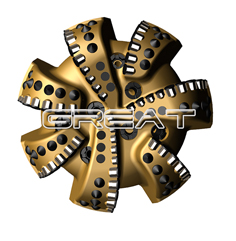
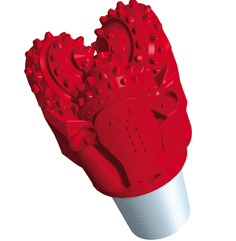
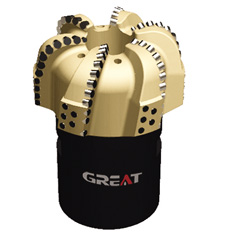
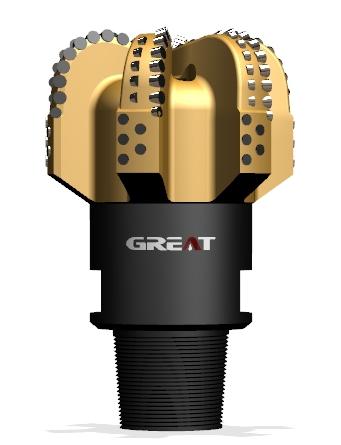
Matrix body PDC bits are made from a tungsten carbide composite, while steel body PDC bits use a steel alloy. The choice between them revolves around formation abrasiveness, repairability, and cost. For hard, abrasive formations, matrix body bits provide superior erosion resistance, but they are more expensive and less repairable than steel body bits. This guide helps B2B system integrators make a data-backed choice.
What Are PDC Bits and Why Does the Body Material Matter?
Polycrystalline diamond compact (PDC) bits cut rock with fixed diamond cutters. According to Baker Hughes, PDC bits are available for a range of drilling applications, and their design must align with formation properties. The body material—matrix or steel—determines erosion resistance, strength, and service life.
Matrix body bits are formed by infiltrating tungsten carbide powder with a binder alloy. Steel body bits are machined from a steel blank. Each approach has tradeoffs that affect drilling economics. The body material also influences the bit's response to cutter loading and hydraulic forces.
What Is a Matrix Body PDC Bit?
Matrix body PDC bits consist of a tungsten carbide matrix infiltrated with a copper or nickel-based binder. They are manufactured through a powder metallurgy process, which gives the bit high hardness and resistance to abrasive wear. According to Halliburton, matrix bits are often recommended for abrasive formations because of their durability.
The infiltration process allows the creation of complex internal cavities for nozzles and cutter seats. This design flexibility can improve hydraulic efficiency and cutter cooling. However, the process is time-consuming and less flexible for design changes after manufacturing. Matrix bits typically have a higher tungsten carbide content, resulting in excellent erosion resistance in high-velocity drilling fluids.
In a comparative study reported by OnePetro, matrix body bits showed a 15% lower erosion rate than steel bits in a high-abrasion sandstone formation. This type of data is critical for system integrators planning long interval runs where bit wear can dominate cost.
What Is a Steel Body PDC Bit?
Steel body PDC bits are machined from a steel alloy blank, then heat-treated. The steel body offers higher ductility, making it more resistant to impact damage. According to Baker Hughes, steel body bits are generally easier to repair and can be re-tipped with new cutters, extending service life at a lower cost.
Steel bits are typically lighter than matrix bits, which can reduce weight on the drillstring. They also have a lower initial cost, making them attractive for softer formations where erosion is not the primary concern. Steel body bits can be welded and re-machined in the field, reducing logistics costs for remote operations.
However, steel body bits erode faster in abrasive environments. The steel material is softer than tungsten carbide, so the body can erode behind the cutters, leading to reduced support and premature cutter loss. In such conditions, the lower upfront cost may be offset by shorter run length.
What Are the Key Differences Between Matrix and Steel Body PDC Bits?
The following table summarizes the main differences. Specific values depend on the bit design and manufacturer. For exact data, consult the bit supplier.
| Attribute | Matrix Body | Steel Body |
|---|
| Material | Tungsten carbide composite | Steel alloy |
| Erosion resistance | High | Low to medium |
| Impact toughness | Medium | High |
| Repairability | Difficult; re-infiltration required | Easy; can be welded and re-tipped |
| Typical cost | 20–50% higher than steel | Lower |
| Weight | Heavier | Lighter |
| Typical application | Abrasive, hard formations | Soft to medium formations |
Note: Erosion resistance and impact toughness are qualitative. Quantitative comparisons depend on specific alloy compositions and heat treatments. Always request test data from the manufacturer before final selection.
How Do Cutter Size, Shape, and Count Affect PDC Bit Selection?
PDC cutters are made of a polycrystalline diamond layer on a tungsten carbide substrate. Cutter size (diameter), shape (round, shaped, or polished), and count directly affect penetration rate and durability. Larger cutters (e.g., 16 mm vs 13 mm) generate more energy per contact point, but may be more prone to impact damage.
According to Baker Hughes, cutter selection depends on formation hardness and expected downhole conditions. For hard formations, smaller cutters with a heavier chamfer are recommended to reduce chipping. For soft formations, larger cutters with a sharper edge increase rate of penetration (ROP). The cutter count is balanced with blade count to ensure sufficient diamond density on the face.
The body material influences cutter mounting. Matrix bodies allow deeper set pockets, which protect cutters from erosion. Steel bodies have shallower pockets, making cutters more exposed. In abrasive formations, this can lead to faster cutter loss on steel body bits. In contrast, matrix bits maintain cutter support longer, preserving the cutting structure.
In a field study published on OnePetro, 16-mm cutters on matrix bits outperformed 13-mm cutters in a soft-to-medium sandstone by 25% in ROP. However, the optimal size is formation-specific and must be validated with local data.
How Do Blade Count and Hydraulics Affect Bit Performance?
Blade count determines cutter support and junk slot area. Fewer blades provide more open space for cuttings evacuation, which helps in soft formations. More blades add cutter density and support, which is useful in hard formations. A matrix body can be cast with complex hydraulic shapes, including extended nozzles, reducing erosion at critical points. Steel body bits can be machined with similar features, but may be more prone to erosion over time.
Hydraulic design includes nozzle size, position, and flow rate. Adequate flow is needed to clean cutters and convey cuttings to the annulus. Poor hydraulics can lead to bit balling in soft formations, while excessive flow can cause erosion in steel body bits. According to OnePetro, optimized nozzle placement on matrix bits improved cuttings removal by 30% in a test well.
For system integrators, the interaction between blade count, cutter size, and hydraulic design is critical. A matrix body allows more complex internal hydraulic geometry, which can improve performance in high-temperature and high-pressure wells. However, the manufacturing cost is higher.
When Should You Choose a Matrix Body PDC Bit?
Choose a matrix body bit for abrasive formations, high compressive strength, and sections where erosion is a risk. The higher upfront cost is offset by longer life and reduced trips. In a case study from OnePetro, matrix bits showed a 35% longer run length than steel bits in a quartz-rich formation.
Matrix bits are also preferred when the drilling window is narrow and bit failure would be costly. Their erosion resistance ensures consistent gauge diameter throughout the run, reducing the risk of reaming. However, matrix bits are more difficult to repair. If the bit is damaged, the repair cost can be high, and the turnaround time may be longer.
When Should You Choose a Steel Body PDC Bit?
Choose a steel body bit for softer formations, lower abrasivity, and when you need lower initial cost or easy repairability. Steel body bits are also preferred when weight is a concern, as they are typically lighter than matrix bits. According to Halliburton, steel body PDC bits can be re-manufactured, extending their useful life.
Steel bits can be re-dressed and re-tipped with new cutters after a run. This is a significant economic advantage if the bit is not severely worn. In a cost analysis from Baker Hughes, the total lifecycle cost of a steel bit in a soft sandstone was 18% lower than a matrix bit, even after two repairs.
However, steel bits may require more frequent trips in abrasive formations, increasing intangible drilling time. The decision should be based on a complete economic model, not just the bit purchase price.
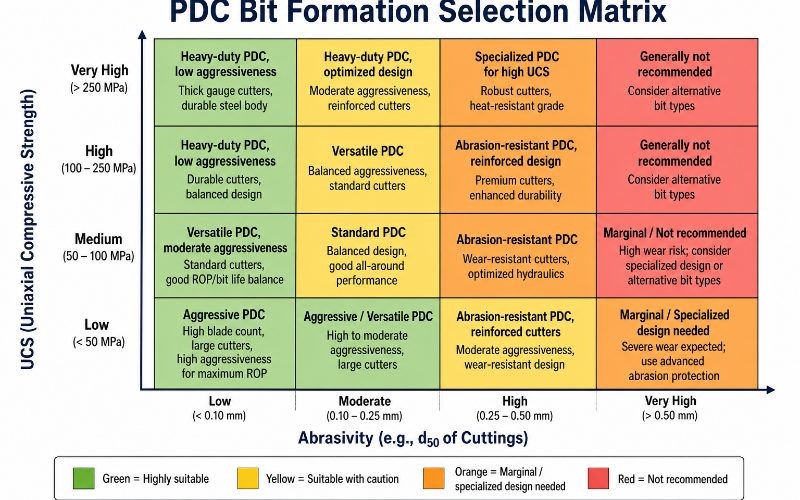
What Is the Formation-by-Formation Selection Matrix for PDC Bits?
To simplify selection, the following matrix maps formation properties to recommended body type and cutter configuration. The recommendations are based on industry practice and the referenced manufacturers' guidance. Specific values should be confirmed with the bit manufacturer.
| Formation Type | UCS (MPa) | Abrasivity | Recommended Body | Cutter Size | Blade Count |
|---|
| Soft (clay, salt, anhydrite) | <35 | Low | Steel | 16 mm | 4–5 |
| Medium (sandstone, shale) | 35–70 | Medium | Steel or Matrix | 13–16 mm | 5–6 |
| Hard (limestone, dolomite) | 70–140 | Medium | Matrix | 13 mm | 6–7 |
| Abrasive (quartzite, conglomerate) | >140 | High | Matrix | 9–11 mm | 7–8 |
Note: UCS (unconfined compressive strength) values are approximate and vary with depth, pore pressure, and temperature. Abrasivity is often measured by the Cerchar Abrasive Index (CAI). For a specific application, obtain core data or drill-cutting analysis to refine the selection.
How Do Cost and Repairability Affect Lifecycle Economics?
The total cost of a PDC bit includes purchase price, repair cost, and the cost of time spent tripping and drilling. Matrix bits generally cost 20–50% more than steel bits of the same diameter. However, in abrasive formations, they can last longer, reducing the number of trips.
Repairability: Steel bits can be repaired by welding on new cutter pockets and re-tipping. Matrix bits are difficult to repair because the matrix material cannot be easily welded. In some cases, matrix bits can be rebuilt by re-infiltration, but this is more costly and may require factory service. For remote operations, the logistics of shipping a matrix bit back to a service center must be considered.
A cost-per-foot analysis is essential. For a 1,000 m interval in an abrasive formation, a matrix bit might achieve a 500 m run, whereas a steel bit might only achieve 350 m. Depending on trip time and daily rig cost, the matrix bit can be more economical even at a higher purchase price.
Where Can You Find Field Data and Technical Papers for PDC Bit Selection?
OnePetro hosts a comprehensive database of drilling papers, including many on PDC bit selection and performance. Search for "PDC bit selection" to find field case studies and laboratory tests. The link is OnePetro.
Additionally, Halliburton and Baker Hughes publish detailed product specifications and application guides on their websites. These are valuable for understanding the latest bit designs. Halliburton and Baker Hughes both provide technical resources that can be used to validate your selection.
For a system integrator, using field data to validate bit performance is essential. The formation-by-formation matrix above should be adapted with local data from offset wells. Consider partnering with a bit supplier that offers performance prediction services.
Conclusion: How Do You Make the Final Decision?
The decision between matrix and steel body PDC bits is not binary. It depends on formation characteristics, cost objectives, and logistics. Use the selection matrix as a starting point, then validate with bit-specific data from suppliers.
For further assistance, contact a reputable bit manufacturer with your formation data, drilling plan, and operational constraints. Engineering judgment, coupled with field data, will yield the most economical drilling plan.
 English
 français
 Deutsch
 Español
 italiano
 русский
 português
 العربية
 tiếng việt
 ไทย
ไทย Nederland