Directional drilling continues to expand across telecommunications, oil & gas, pipeline installation, and urban utility development. And while technology has advanced, one constant remains:
If your HDD hole opener is not operated safely and correctly, the project risks downtime, damaged tools, and spiraling costs.
This guide explains how to safely use an HDD hole opener in real-world drilling applications, prevent failure, and maximize the lifespan of reaming tools such as GreatDrillbit’s Rock Reamer HDD hole opener.
What Is an HDD Hole Opener?
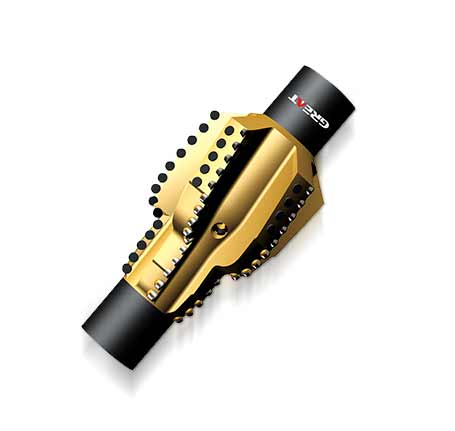
An HDD hole opener (also commonly called a reamer) is used to enlarge the pilot hole to the final required diameter before pipe pullback.
They are designed to handle difficult subsurface formations such as:
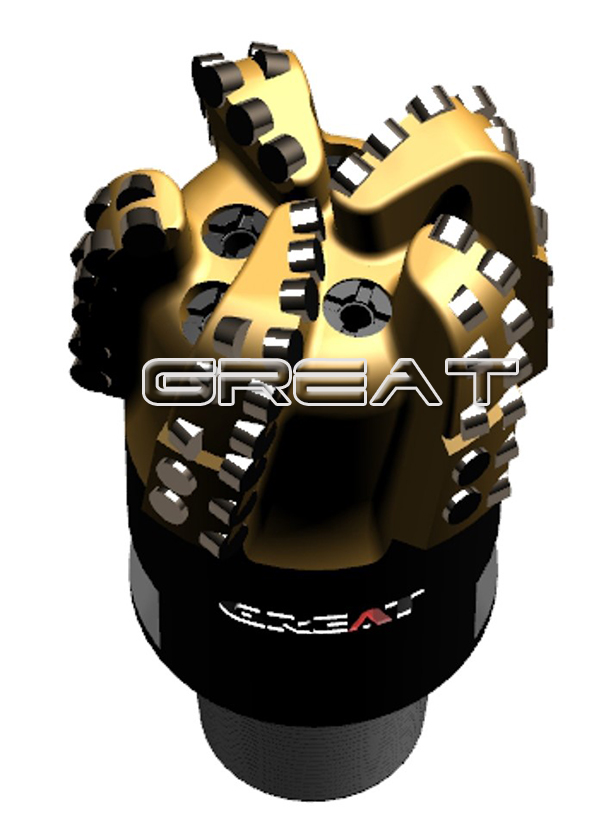
GreatDrillbit’s rock reamers use interchangeable cutters and a heavy-duty body to ensure:
Stable cutting in high-load drilling
Reduced vibration and torque spikes
Longer cutter life
Lower cost per foot drilled
But no matter how strong the reamer is, correct operation is key to performance and safety.、
Why Safe Operation Matters
Improper use of an HDD hole opener can result in:
❌Overheating and cutter failure
❌Weld cracking or string damage
❌Downhole jamming and stuck pipe
❌Premature bearing and seal wear
❌Reduced ROP (Rate of Penetration)
❌Increased replacement and downtime costs
Safe operation protects both the rig and the tooling—and ensures you get maximum value from a premium hole opener.
1. Start With a Properly Sized Pilot Hole
A safe reaming operation always starts with a clean and correctly sized pilot hole.
Best practices:
Ensure the pilot hole is straight and aligned to the planned pullback path
Diameter should be at least 30%–40% smaller than the first reaming pass
Remove cuttings fully before reaming begins
A poor pilot hole increases side loading and damaging torsional forces on the HDD hole opener.
2. Use the Right Reaming Sequence
Never jump directly from the pilot hole to the final diameter unless the ground is extremely soft.
Typical safe expansion sequence:
4 inch → 8 inch → 12 inch → 18 inch → 24 inch → final size
On harder formations like granite, limestone, or cobble, follow smaller increments.
This protects:
Cutters
Stabilizer arms
Drill string
Rig torque capacity
If the rig continuously overloads, downsize the reaming step.
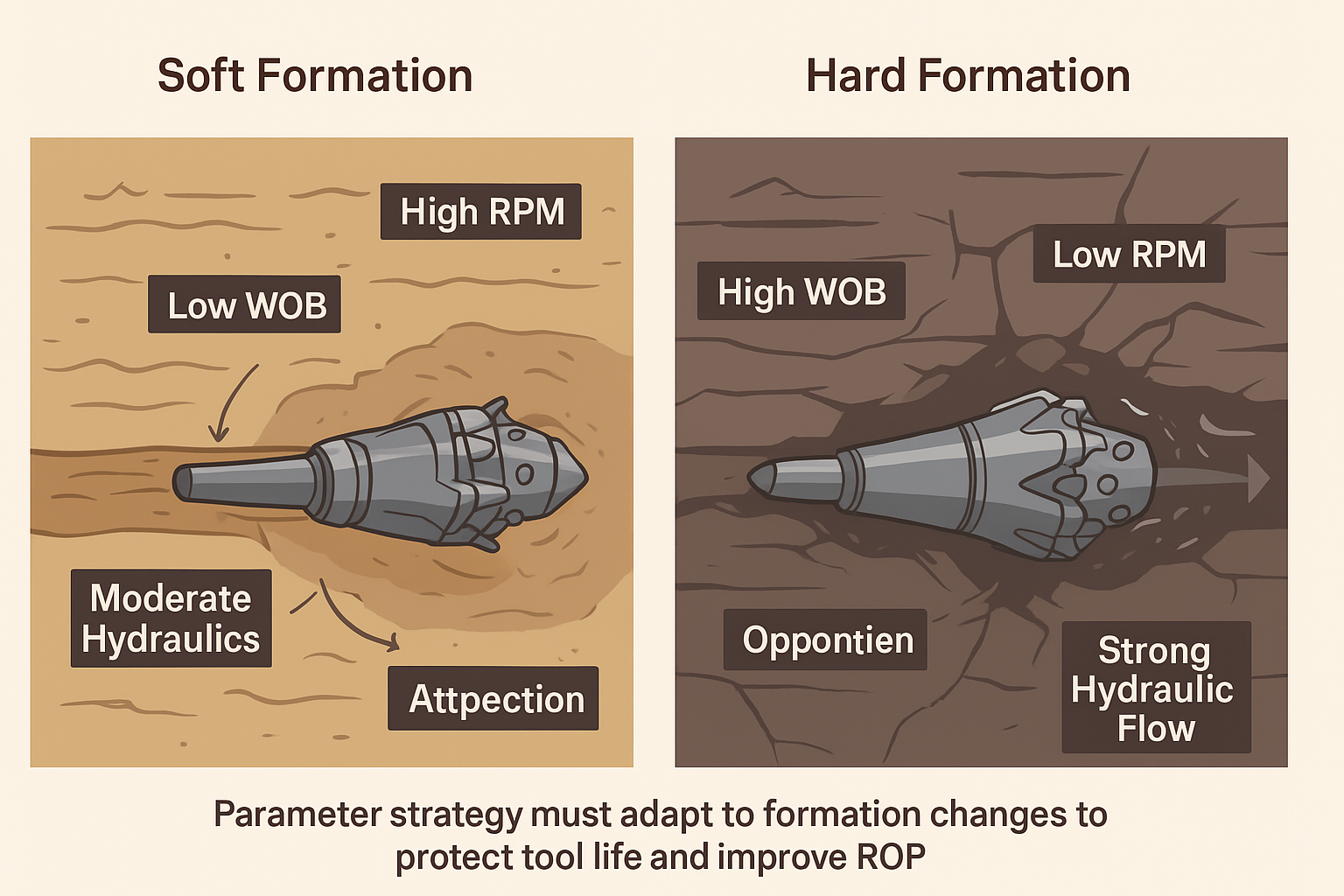
3. Match Rotation Speed and Thrust to Ground Conditions
Incorrect rotary speed (RPM) and thrust (WOB) are two of the fastest ways to damage a reamer.
In Soft Soil
✔ Higher RPM
✔ Lower thrust
✔ Moderate fluid
In Hard Rock
✔ Lower RPM
✔ Higher thrust
✔ Strong hydraulic cleaning
Too much RPM in hard formations can:
This is why GreatDrillbit HDD hole openers use:
tough carbide-based cutters and reinforced tool body
to resist impact and torque fluctuations.
4. Maintain Proper Drilling Fluid Flow
Drilling mud is both:
A cooling system
A cleaning system
Insufficient flow can cause:
❌Heat buildup
❌Bit balling
❌Stall or torque spikes
❌ Tool wear
Safe HDD reaming requires:
“Increasing torque without increased penetration is an early warning sign the reamer is working in poor fluid conditions.”
5. Check Torque and Pull Load in Real Time
Instrument readings reveal tool stress before failure occurs.
Watch for:
Stop the run immediately if:
Torque reaches rig limits
The drill string begins to chatter
The reamer is suspected to be grinding instead of cutting
This prevents:
6. Avoid Reverse Rotation Unless Necessary
Reverse rotation should only be used to:
Many HDD reamers—including heavy-duty rock types—are designed primarily for forward stress. Prolonged reverse rotation can:
If reverse rotation is required, keep RPM low and monitor torque closely.
7. Perform Cutter Inspection Between Runs
Even high-grade reamers require inspection at reaming stage intervals.
What to check:
✔ Tungsten carbide cutter wear
✔ Bearing contamination
✔ Seals and lubrication
✔ Joint tightness
✔ Stabilizer plate condition
✔ Cracks or heat discoloration
GreatDrillbit’s reamers with interchangeable cutters allow:
If the cutters wear unevenly, adjust drilling parameters before the next pass.
8. Store and Maintain Your HDD Hole Opener Correctly
After every project:
Wash drilling mud off completely
Inspect lubrication points
Coat with protective oil
Store in a dry, covered environment
Neglected storage can allow:
Rust
Corrosion
Seized bearings
Damage during transport
Proper maintenance extends tool life significantly.
Why GreatDrillbit Rock Reamers Improve Safety and ROI
GreatDrillbit’s HDD hole openers are engineered for demanding drilling conditions and deliver:
✔ High-strength alloy steel body
✔ Carbide-based replaceable cutters
✔ Smooth cutting structure balanced for reduced vibration
✔ Extended cutter service life
✔ Lower cost per foot drilled
✔ Custom sizes for different hole diameters
Whether you are drilling sandstone, limestone, cobble, or mixed formations, choosing a precision-built reamer helps operators:
Final Thoughts
Safe and effective HDD reaming is a combination of:
Even the strongest HDD hole opener performs best when:
GreatDrillbit’s rock reamers give you the structural strength and cutter durability to drill confidently, project after project.
Talk to Our HDD Experts
Need help selecting the right HDD hole opener for your:
Rock drilling
Urban utility
Pipeline crossing
Telecom trenchless line
Contact GreatDrillbit today and get a professional recommendation based on your formation and drilling rig setup.
 English
 français
 Deutsch
 Español
 italiano
 русский
 português
 العربية
 tiếng việt
 ไทย
ไทย Nederland